3 Days in Kyoto: A First-Timer's Itinerary
July 14, 2026 · 7 min read
Three days isn't really long enough for Kyoto, but it's long enough to fall for it properly. With well over a thousand temples and a city that rewards a slow start to the morning, the trick on a first visit is to keep each day in one part of town, get ahead of the crowds where you can, and leave enough slack to just wander. Here's a walkable 3-day plan we've tested, plus the timing tips that actually make a difference.
How to use this Kyoto itinerary
This plan groups stops by area so you're not zigzagging across the city all day. Each day sits roughly in one part of Kyoto (east, west, north), which keeps the journeys short and your feet happier.
A few things before you start:
- Mornings are your secret weapon. Kyoto's famous sights fill up fast by mid-morning. If you take one tip from this whole post, make it this: start early.
- Get an IC card (Suica or ICOCA) so you can tap straight onto buses and trains. Kyoto's buses cover the gaps the subway misses.
- Wear proper shoes. This is a walking city, and the temple paths aren't gentle.
Want this as a living plan you can edit on your phone, with offline maps and the ability to re-plan on the ground? Have a look at the Kyoto plan on Travolp or download the app. And if you'd rather have AI put together a version tuned to your own taste, start with how to plan a trip with AI first.
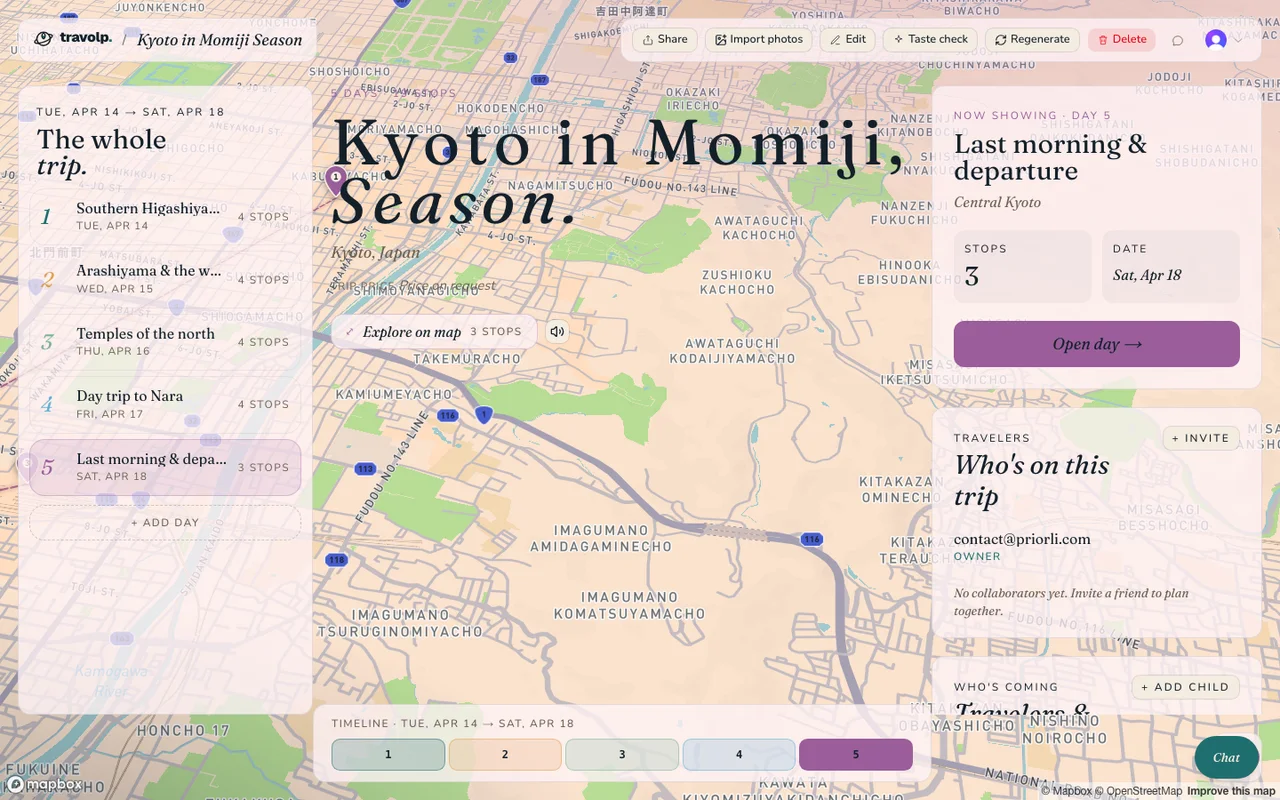
The same plan inside Travolp: days grouped by area, every stop mapped and easy to reorder.
Day 1: Southern and Eastern Kyoto: Fushimi Inari and Kiyomizu-dera

Day one covers two of Kyoto's best-known sights, and both reward an early start more than almost anywhere else in the city.
Morning: Fushimi Inari Shrine
Start here, and start early: ideally by 7.30 or 8am. Fushimi Inari is the shrine with the endless tunnel of vermilion torii gates climbing the mountain. It's free, open around the clock, and best when it's quiet.
- The full loop to the summit and back takes 2 to 3 hours. Most people turn back at the Yotsutsuji junction (30 to 45 minutes up) for a great view over the city, and that's a perfectly good plan too.
- By 10am it's shoulder to shoulder near the entrance. The higher you climb, the thinner the crowds get.
Afternoon: Kiyomizu-dera and the Higashiyama lanes
From Fushimi Inari, head north into the Higashiyama district. Grab lunch around Gion or the lanes below the temple.
- Kiyomizu-dera is the wooden temple built on stilts, with the famous veranda hanging out over the hillside. It's especially good in late afternoon light.
- The approach streets, Sannenzaka and Ninenzaka, are preserved sloping lanes lined with sweet shops, tea houses and craft stores. Give yourself time to just wander through them.
Evening: Gion
Finish the day in Gion, Kyoto's geisha district. Walk down Hanamikoji Street at dusk, when the wooden machiya townhouses glow under lantern light, and you might spot a geiko or maiko hurrying to an appointment. (Be respectful: photographing them on the street is discouraged.)
Day 2: Western Kyoto: Arashiyama bamboo grove and the monkeys
Day two heads west to Arashiyama, a half-rural district of bamboo, river and mountain temples. It's far enough out that it deserves a full day rather than a squeeze-in.
Morning: Arashiyama Bamboo Grove
Once again: get there early. The Bamboo Grove is a short path through towering green stalks that feels like nowhere else in Kyoto, but it's small, and by mid-morning it's a slow-moving river of people. Turn up by 8 or 8.30am and you might have a stretch of it almost to yourself.
- Right next to the grove is Tenryū-ji, a Zen temple with one of Japan's finest gardens and a mountain backdrop behind it. Worth the entry fee.
Midday: Iwatayama Monkey Park and the river
- Cross the Togetsukyo Bridge for views up the Hozu River gorge.
- If you fancy a climb, the Iwatayama Monkey Park rewards a steep 20-minute hike with wild macaques and a wide view back over Kyoto.
- Have lunch by the river and slow right down. Arashiyama is a place for lingering, not rushing.
Afternoon: Okochi Sanso or a stroll through Sagano
The Okochi Sanso Villa (once home to a samurai-film actor) has quiet gardens and a cup of matcha included with admission, a calm antidote to the morning's crowds.
Day 3: Northern Kyoto: Kinkaku-ji and the Philosopher's Path

Save the gold for last. Day three pairs Kyoto's most photographed temple with one of its nicest walks.
Morning: Kinkaku-ji (the Golden Pavilion)
Kinkaku-ji, the Golden Pavilion, is a three-storey temple covered in gold leaf and mirrored in the pond in front of it. It's small and you can't go inside, so 45 to 60 minutes covers it comfortably. Go at opening (9am) to photograph it before the tour buses turn up.
- If you've got the energy for more, nearby Ryōan-ji has Japan's most famous rock garden, fifteen stones set in raked gravel and a proper lesson in restraint.
Afternoon: The Philosopher's Path and Ginkaku-ji
Move over to the eastern hills for the Philosopher's Path, a stone walkway that follows a canal lined with cherry trees (glorious in spring, peaceful at any time of year) and dotted with small temples, cafés and shops.
- At the northern end sits Ginkaku-ji, the Silver Pavilion, which was never actually silver but has beautiful moss and sand gardens. A calm, fitting way to close out the sightseeing.
Evening: Pontocho for dinner
End your trip on Pontocho, the narrow lantern-lit alley by the Kamo River lined with restaurants serving everything from kaiseki to yakitori. In the warmer months, many places open riverside dining platforms known as kawayuka. A good note to finish on.
Practical Kyoto tips that save the day
- Best times to visit: spring (late March to April, for the cherry blossoms) and autumn (November, for the colours) bring the biggest crowds. Summer is hot and sticky; winter is cold, clear and quiet.
- Getting around: buses and trains cover everything, and an IC card makes it painless. A taxi is worth the money when you're tired and a long way from a stop.
- Temple hours: most close around 4.30 or 5pm, so plan your sightseeing for the first half of the day.
- Etiquette: keep your voice down on temple grounds, take your shoes off where you're asked to, and don't block the narrow lanes for photos.
- Cash: still handy at smaller shops and shrines, though cards are accepted more widely these days.
Make this Kyoto plan your own

Three days, one area a day, early starts. That's the formula. But the best version of this trip is the one shaped around you: maybe you want more food and fewer temples, or a slower pace with kids in tow.
That's exactly what an AI travel companion is good for. With Travolp you can take a Kyoto plan, tell it your taste, and reshape it just by chatting, then carry it with you using offline maps (so it still works with no signal up in the temple hills) and Lens to identify the artwork and statues you come across. Curious how the planning side works? Start with how to plan a trip with AI.
When you're ready, have a look at the Kyoto plan and download Travolp to make it yours.